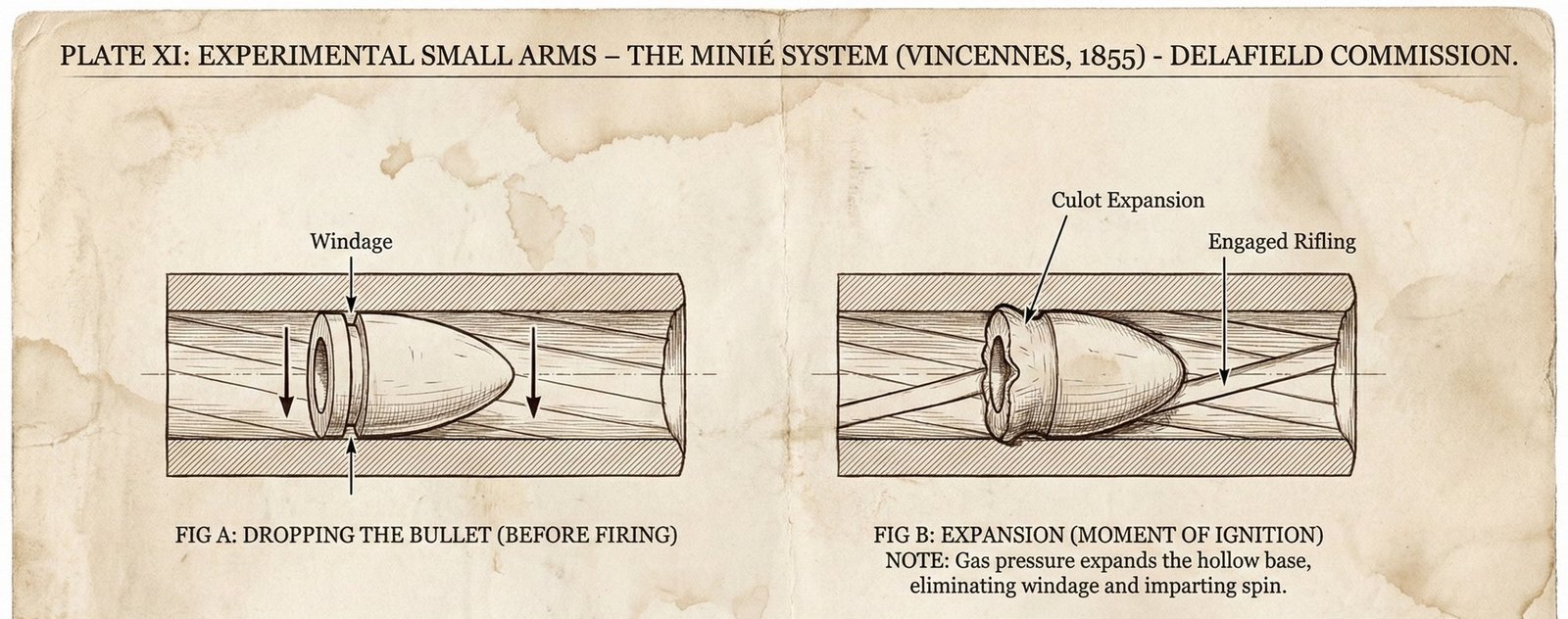
Early rifles needed a mallet. The bullet needed to grip the grooves inside the barrel, so soldiers hammered it down the bore with a ramrod. Powder residue built up with every shot and made loading harder.
Quick answer: The Minié ball was a soft lead bullet with a hollow base. It loaded easily down a rifled barrel. When the gun fired, the base spread into the grooves and spun the bullet. The U.S. Army adopted the rifle-musket in 1855. It could hit a man at 200 to 400 yards, yet most regiments still opened fire near 100.
What does rifling do?
Rifling is a set of spiral grooves cut inside a gun barrel. The grooves grip the bullet and spin it as it leaves the muzzle, the way a quarterback spins a football. A spinning bullet flies straighter and travels farther.
Gunsmiths cut straight grooves into barrels by 1480, at first to collect soot. Spiral grooves followed, with attempts recorded in 1498 and 1520. For centuries, rifles stayed mostly with wealthy hunters. Armies kept smoothbores because rifles cost more and were hard to load and clean.
Who invented the Minié ball?
In the 1820s, a French army captain named Henri-Gustave Delvigne tried to fix the loading problem. His ball expanded when the soldier rammed it. In 1849, another French officer, Claude-Étienne Minié, designed a better bullet.
The new bullet was a cone of lead with a hollow base, loose enough to slide down a dirty barrel. When the gun fired, gas pushed into the hollow and spread the soft lead skirt against the grooves.
James Burton, an armorer at Harpers Ferry, dropped Minié’s iron plug and deepened the cavity. That made the bullet easier and cheaper to mass-produce. The new bullet weighed about 1.14 ounces, and the U.S. Army adopted the rifle-musket in 1855.
Which rifle-muskets fired the Minié ball?
The Springfield Model 1855 fired a .58 caliber bullet, smaller than the .69 caliber ball of the older musket. Army tests found the smaller bore more accurate. Its Maynard tape primer misfired about half the time in 1859 and 1860 tests. The Model 1861 returned to the percussion cap and became the Union’s main infantry weapon.
Britain built the Pattern 1853 Enfield, whose 39-inch barrel sent a bullet out at about 1,250 feet per second. Both armies used it.
An older musket worked at 50 to 100 yards. A rifle-musket could hit a man at 200 to 400 yards, and marksmen reached 500.
Did the Minié ball increase combat range?
Contemporaries saw a rifle that reached 500 yards beside a smoothbore that reached 100. They assumed the new gun prolonged the war. Historian Earl Hess challenged that view and found that regiments with rifle-muskets opened fire at about 100 yards.
A publisher’s summary of his book gives three reasons. Soldiers received too little training, preferred short-range fire, and could not see the enemy at a distance. The bullet’s path added a fourth problem.
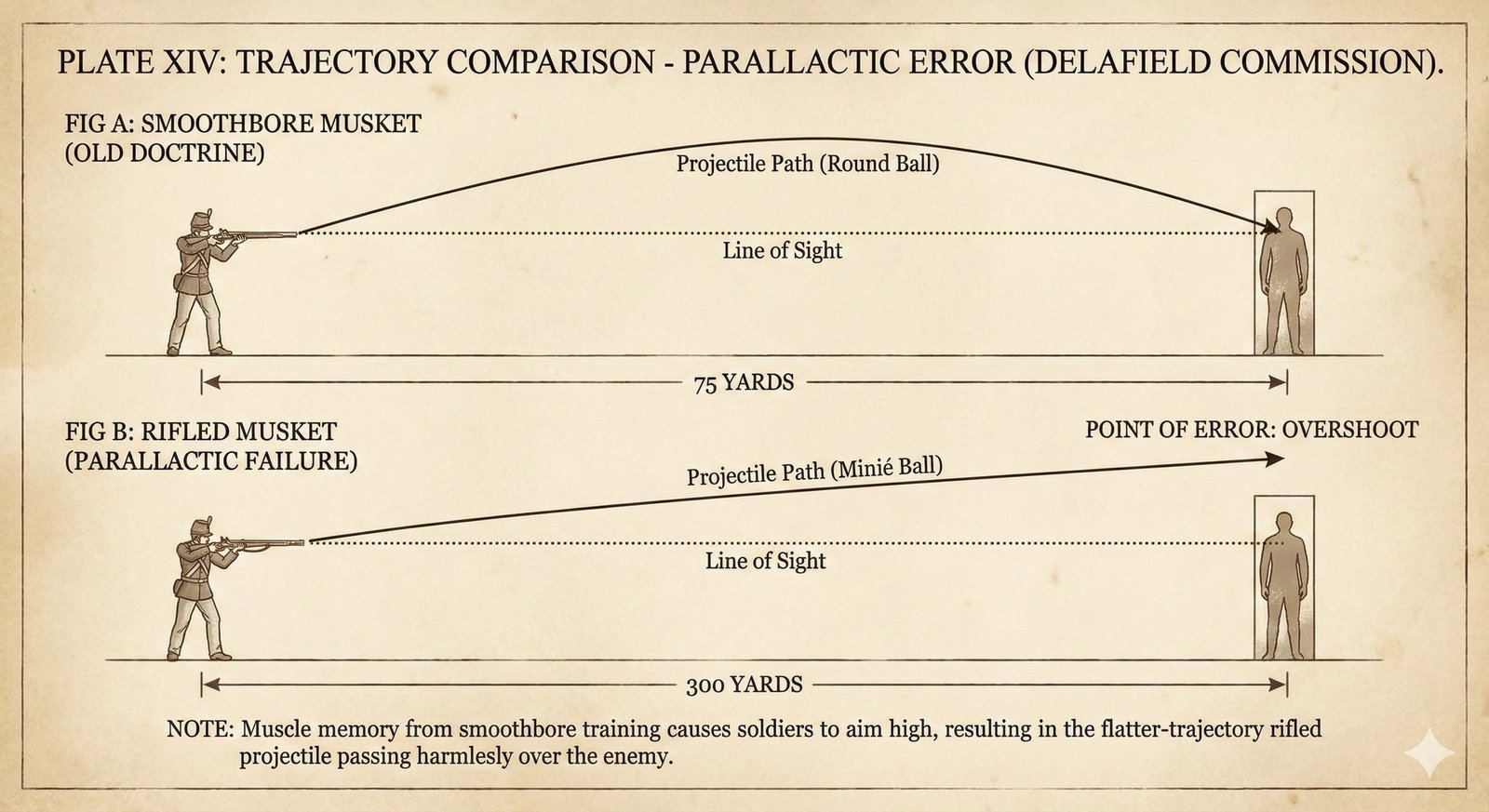
Reviewing Hess’s book, Jonathan Jones describes a 300-yard shot. The ball flew flat for about 100 yards. It then rose 20 to 100 feet above a soldier’s head. It dropped into a strike zone about 75 yards deep. That left two killing zones with a gap between them. A soldier who misjudged the range sent his shot over the enemy’s heads.
Who used the rifle’s long range?
Trained marksmen used the reach. In 1861, Hiram Berdan raised two regiments of U.S. Sharpshooters. Recruits needed to put ten shots in a ten-inch ring at 200 yards. Berdan’s men later switched to Sharps breechloaders, which load from the rear. Confederate marksmen carried Enfields, imported Whitworths, and rifles from home.
Sharpshooters picked off officers, artillery crews, and skirmishers, the thin line of soldiers who advanced ahead of the main force. They fired from fences, buildings, and rifle pits. During the sieges of Yorktown and Petersburg, they dueled at long range. HistoryNet argues that this threat pushed soldiers toward cover and fortifications.
On May 9, 1864, at Spotsylvania, a Confederate sharpshooter killed Major General John Sedgwick. One account names a Whitworth rifle and an 800-yard shot. Sources differ on who fired, and at least two South Carolina marksmen claimed the credit.
Neither the Whitworth nor the Sharps was a Minié muzzle-loader. These cases show what long-range rifles could do.
What wounds did the Minié ball cause?
The Minié ball was soft lead, so it flattened and splintered bone and drove dirt and cloth into the wound. Infection followed. About 70 percent of the wounded in hospitals took hits to the arms or legs.
Bullets, shell fragments, sabers, and bayonets wounded an estimated 476,000 soldiers. Three of every four operations were amputations. Union surgeons performed nearly 30,000, and Confederate surgeons performed about 25,000. About 27 percent of the Union amputees died. Patients survived more often when surgeons operated within 48 hours instead of waiting.
How many casualties did the Minié ball cause?
Historians disagree about how far the Minié ball reshaped the war. The Essential Civil War Curriculum credits small arms with half of the war’s 633,000 killed and wounded. History.com puts the rifle musket and Minié ball at around 90 percent of casualties. Reviewer Stephen Edwards works backward from Hess’s artillery and bayonet figures and gets 73 to 79 percent for small arms.
Hess argues that the rifle musket changed the battle line less than historians assumed. In his view, its effect stayed mostly with skirmishers and snipers. Jones questions Hess’s claim about the bullet’s exit speed.
The line regiments mostly held their fire until the enemy stood about 100 yards away, the old smoothbore distance. Most battles stayed inside that range.
Hashtags: #CivilWar #CivilWarHistory #CivilWarWeapons #MinieBall #RifleMusket #Sharpshooters #CivilWarMedicine
For another look at what new weapons changed on the battlefield, read how rifled cannon changed Civil War fighting. To explore the era through fiction, read a free opening chapter from Steel and Honor.
Sources
- History.com, “Minié Ball”
- Wikipedia, “Minié ball”
- Wikipedia, “Rifling”
- Wikipedia, “Springfield Model 1855”
- Wikipedia, “Pattern 1853 Enfield”
- Wikipedia, “Springfield Model 1861”
- Hess, “The Rifle Musket in Civil War Combat” (reviews by Jonathan Jones and Stephen Edwards)
- Publisher summary of Hess’s book
- HistoryNet, “War Outside the Lines: Sharpshooters”
- Cleveland Civil War Roundtable, “The Sharpshooter and His Weapon”
- American Battlefield Trust, “Amputations and the Civil War”
- Essential Civil War Curriculum, “The Wounded”
- Essential Civil War Curriculum, “Small Arms and Ammunition”