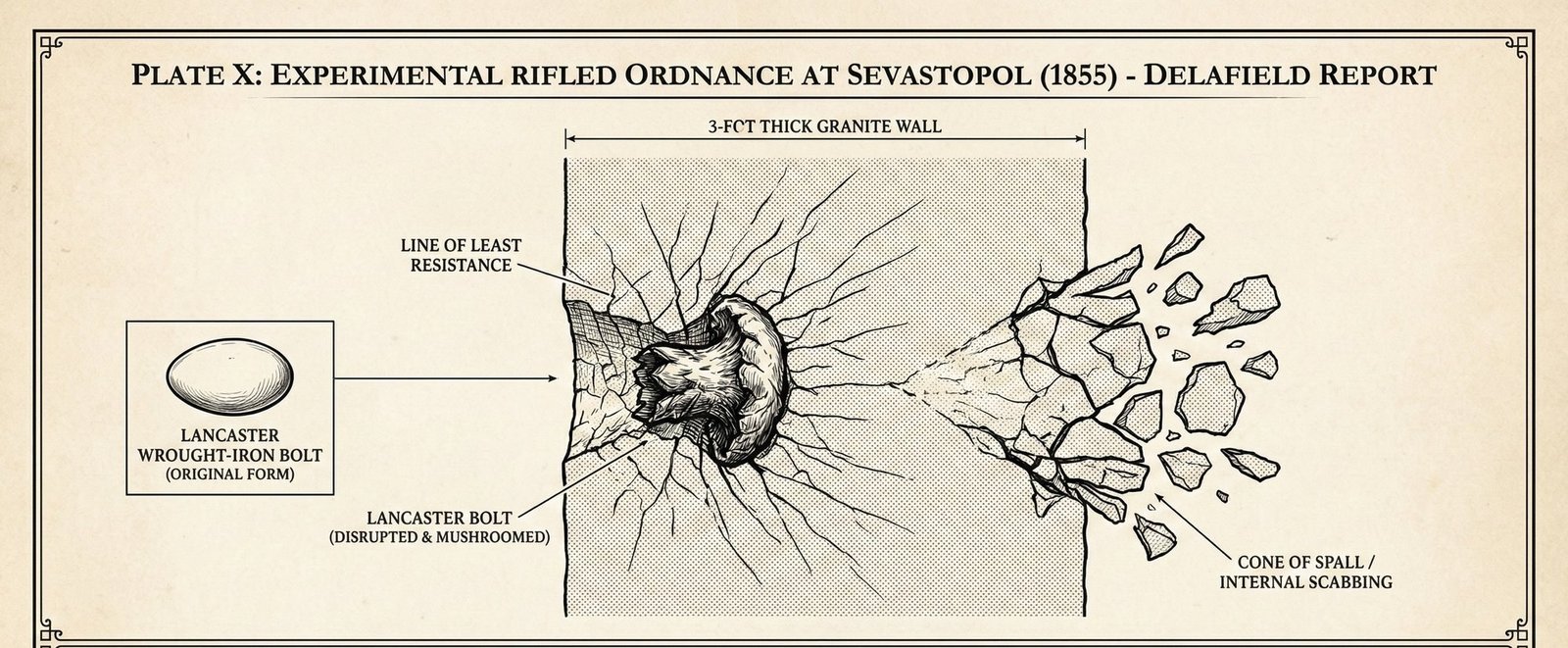
On April 10, 1862, Union batteries opened fire on Fort Pulaski. James rifles in Battery McClellan fired from 1,650 yards. The walls were 7.5 feet of solid brick. Parrott and James rifles and working columbiads breached the southeast corner by nightfall. Colonel Charles Olmstead surrendered at 2:30 p.m. on April 11, about 30 hours after the bombardment began.
Quick answer: Rifled cannon used spiral grooves to spin a long projectile for more range and accuracy. In April 1862, Union James and Parrott rifles helped breach Fort Pulaski’s brick walls in about 30 hours. A later assessment called masonry forts obsolete. In the field, rifled guns brought burst barrels, faulty fuzes, and ammunition mix-ups.
Beyond 700 yards, smoothbore guns and mortars stood little chance of breaking heavy masonry. Columbiads were heavy smoothbores, but the sources do not say how close they stood.
How does a rifled cannon work?
Rifling works on a cannon as it does on a rifle. Grooves spin the projectile, and the spin adds range and accuracy. Rifled cannon were much more accurate on average than smoothbores. Rifled guns fired long, bullet-shaped projectiles, while smoothbores fired round shot.
Civil War Medicine says a smoothbore Napoleon could hit a barn at just under a mile. A rifled Parrott at that distance could hit the barn door.
A round shot loses speed quickly. The National Park Service says it struck at about a third of its muzzle velocity at 2,000 yards. Wikipedia’s Parrott page puts that point at 1,500 yards.
Getting the projectile to grip the grooves was the hard part. James projectiles fouled the grooves. Gunners scraped them clean after every half dozen shots. Brass-banded projectiles skipped that step.
What were the main Civil War cannons?
Each gun fired with the barrel raised 5 degrees. The Napoleon reached 1,619 to 1,680 yards, the 3-inch rifle 1,830, and the 20-pounder Parrott 1,900.
The 12-pounder Napoleon was the most popular smoothbore of the war. The bronze gun was dependable and deadly with canister at close range. The Union chief of ordnance reported no instance of a Napoleon bursting.
The 3-inch Ordnance rifle was a wrought iron gun, and records show only one burst in action. The Confederates lacked the technology to copy it reliably. Their cast iron versions earned a bad reputation for bursting, and the army also used captured Union guns.
The 20-pounder Parrott earned a bad name. Its cast iron barrel carried a wrought iron band at the breech. General J. Johnston Pettigrew wrote that half one battery’s shells exploded almost as soon as they left the gun. Henry Hunt, the Union chief of artillery, protested that the Parrotts were “very unsatisfactory.” Two burst at Antietam and one at Fredericksburg. Hunt tried to suppress their use in the Army of the Potomac.
What ammunition did Civil War artillery fire?
Gunners used four main rounds. A bolt was the solid, cylinder-shaped projectile of a rifled gun. A shell was a hollow iron case filled with powder, and it burst into large chunks of iron. Case shot was a shell packed with iron balls, and the Napoleon version held 78. Canister was a can of 27 iron balls packed in sawdust. It opened at the muzzle and worked like a giant shotgun.
Canister was the deadliest round, and infantry feared it most. Sources put its effective range anywhere from under 200 yards to about 400. Hunt believed rifled guns threw canister only half as far as the Napoleon’s 400 yards. One listed battery load held 288 solid shot, 96 shells, 288 case rounds, and 96 canister rounds.
Rifles brought other problems. A smoothbore’s round shot could ricochet across the ground into a line of men. A rifled bolt tended to dig in. Fuzes set off the shells, and their reliability worried gunners. Confederate fuzes often proved inaccurate, so shells burst too early or too late.
How did rifled cannon change forts?
Gillmore’s after-action assessment said good rifled guns, properly served, could rapidly breach brick walls at 1,600 to 2,000 yards. He called the 84-pounder James unexcelled in breaching, though crews needed to keep its grooves clean.
After the war, an assessment concluded that heavy rifled cannon made masonry forts obsolete. Pulaski’s quick fall served to justify stopping work on masonry forts. A brief period of earthwork fort building followed in the 1870s.
Why did rifled cannon struggle in the field?
The field told a different story. One medical source puts artillery at about 12 percent of Civil War casualties and gunshot wounds at 88 percent. Even so, the Union inventory grew from 2,283 guns at the war’s start to 3,325 at its end. Field guns rose from about 10 percent of that total to 53 percent.
Rifles changed forts first. Pulaski fell in about 30 hours, and a later assessment called masonry forts obsolete. In the field, rifles reached farther and shot straighter on average. They also brought burst barrels and fuzes that worried gunners.
On July 3, 1863, Confederate guns opened fire at Gettysburg. The American Battlefield Trust counts about 150 along a two-mile line on Seminary Ridge. Military History Now says about 170. As many as 120 Union guns dueled with them. Smoke hid targets on both sides, and many Confederate shells with defective fuzes flew over their targets.
Rifles added reach. Military History Now says Confederate Whitworths added at least a mile of range to their barrages.
Rifles also added supply trouble. The 10-pounder Parrott came in 2.9-inch and 3.0-inch bores. Loading 3-inch ammunition into the smaller gun jammed it.
After about two hours, Hunt ordered his batteries to slow their fire and save ammunition. The American Battlefield Trust says Hancock told the gunners to return fire. Emerging Civil War says Hunt’s artillery officers sided with him. Hunt also pulled several batteries back near the center of the line.
Colonel Edward Porter Alexander saw Union guns leaving the line and urged General Longstreet to send the infantry forward. Military History Now says limited visibility convinced Confederate commanders that their barrage knocked out most Union batteries. Hunt watched the charge begin from McGilvery’s battery position.
The American Battlefield Trust says Hunt readied his crews to switch to canister as the infantry drew near. When the Confederates moved forward, Military History Now says Hunt’s artillery opened up and shredded the advance.
Hashtags: #CivilWar #CivilWarHistory #CivilWarWeapons #CivilWarArtillery #RifledCannon #FortPulaski #Gettysburg
Sources
- Wikipedia, “Field artillery in the American Civil War”
- Wikipedia, “3-inch Ordnance rifle”
- Wikipedia, “20-pounder Parrott rifle”
- Wikipedia, “10-pounder Parrott rifle”
- Wikipedia, “M1857 12-pounder Napoleon”
- Wikipedia, “Battle of Fort Pulaski”
- National Park Service, Historic Ordnance
- Civil War Medicine, “The Effects of Civil War Artillery”
- American Battlefield Trust, “Gettysburg Artillery Placements, July 3, 1863”
- Emerging Civil War, “Henry J. Hunt, Chief of Artillery”
- Military History Now, “The Guns of Gettysburg”