By Tom O’Connor, USMA ’73 · Last Updated: November 2026
Order a signed copy
Personally signed by Tom O’Connor. Each price includes shipping and handling within the contiguous U.S. Optional personalization at checkout.
Buy the Book
Order from Amazon:
Listen on Spotify
Listen to this Steel and Honor book on Spotify.
Book 3 of Steel and Honor
Status: Published
Two campaigns. Three families. A summer of decision.
About the Book
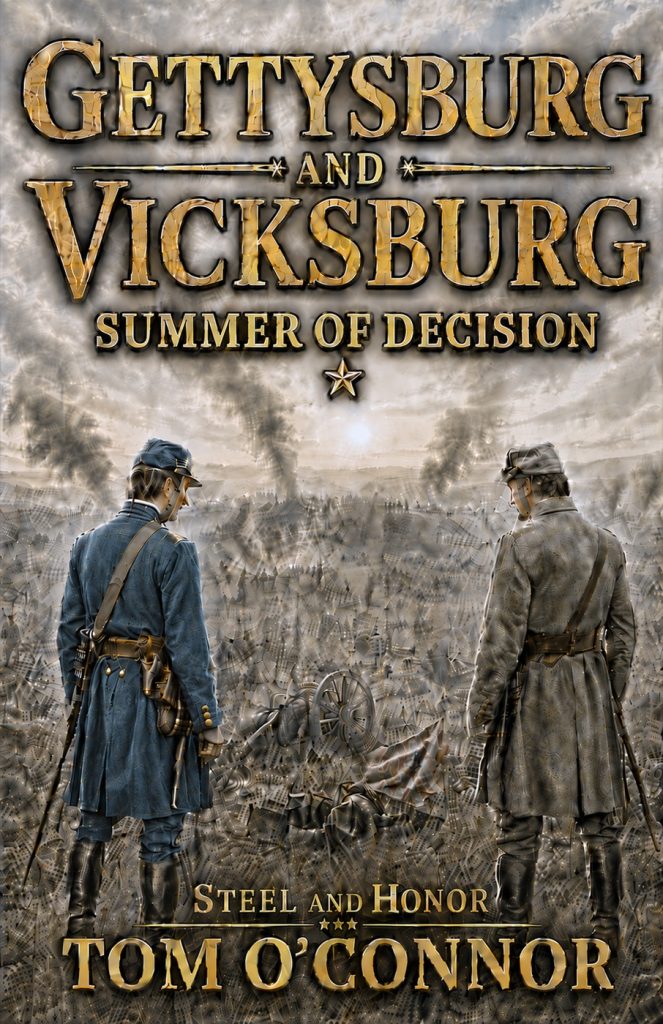
Nathaniel McAllister rides toward Gettysburg. Andrew McAllister follows Grant's campaign against Vicksburg. James Tanner serves the Confederate cause.
Read or Explore
Series Reading Order
Explore the Steel and Honor reading order.
- Book 2: Antietam: From Secession to the Bloodiest Day
- Book 4: Chickamauga and Chattanooga
Ready to Read Gettysburg and Vicksburg?
Order from Amazon:
Two campaigns in one summer
Gettysburg and Vicksburg: Summer of Decision is Book 3 of Tom O’Connor’s Steel and Honor series. It follows three fictional officers through two Union victories in July 1863. Nathaniel McAllister rides toward Gettysburg, Andrew McAllister follows Grant’s campaign against Vicksburg, and James Tanner serves the Confederate cause. The two campaigns run alongside each other in the novel. For the families, the distance between them brings uncertainty as well as danger.
Gettysburg is fought in and around a Pennsylvania town whose roads and ridges influence how the armies concentrate and deploy. Vicksburg is a Mississippi River stronghold whose defenders hold high ground and eventually face a siege. The novel gives readers a way to follow both settings through characters already shaped by the earlier books. It also gives each campaign space to develop on its own terms. The demands of holding a ridge in Pennsylvania differ from the demands of moving troops around a river fortress in Mississippi.
The book comes after Antietam and before Chickamauga and Chattanooga. Readers who know the outlines of July 1863 can use the book to follow the effect of each campaign on the McAllister and Tanner families. Readers new to the history can start with the immediate question facing each officer and use the history links below to explore the broader campaign.
Historical and military engineering highlights
- Why did the roads and ridges around Gettysburg matter? Several roads converged on the town, influencing how troops arrived and where fighting began. The surrounding heights affected observation, defensive positions, and movement. As the armies concentrated, the ground shaped the options open to commanders. Thinking about roads and ridges together helps explain how an encounter developed into a battle fought across several distinct positions.
- Why was Vicksburg so difficult to capture? Vicksburg occupied high ground overlooking the Mississippi River. The stronghold mattered because Confederate control there helped impede Union movement on the river. Grant’s campaign involved maneuver, a crossing south of the city, and an advance inland before the siege. The geography helps explain why success required coordinating land movements and river operations over time.
- What did engineers do during a siege? The work included choosing lines of approach, placing batteries, protecting troops who dug toward defenses, and keeping supplies moving. Progress depended on surveying the ground and judging what men could accomplish under fire. At Vicksburg this work helped turn a position that was costly to attack directly into one the Union could isolate and press over weeks.
People to know
Nathaniel McAllister gives readers a fictional perspective on the Gettysburg campaign. Andrew McAllister follows Union operations against Vicksburg, while James Tanner supplies a Confederate perspective. The historical commanders include George G. Meade and Robert E. Lee at Gettysburg, and Ulysses S. Grant and John C. Pemberton at Vicksburg. The novel’s families connect the campaigns through personal consequences. The historical records explain where and when the armies fought. Reading the two campaigns together also brings out a common problem: news travels slowly, and people at home have to make choices before they know what has happened.
Frequently asked questions
Does the novel cover both Gettysburg and Vicksburg?
Yes. It follows both campaigns in the same volume and uses different characters to carry the action in Pennsylvania and Mississippi.
Did both victories occur on the same day?
The Battle of Gettysburg ran from July 1 to July 3, 1863. Vicksburg surrendered on July 4, giving the Union two major successes within a few days.
Where should I begin if I’m new to Steel and Honor?
Start with Cadets to Captains to meet the characters before the Civil War. If you want to sample Book 3 first, you can request its opening chapter by email.
Start reading
Get Chapter One free by email · Amazon Kindle · Amazon paperback · Spotify · Signed five-book bundle
Historical background Why July 1863 changed the war and Gettysburg National Military Park.