On July 1, 1863, Lieutenant Marcellus Jones of the 8th Illinois Cavalry raised a Sharps carbine near Gettysburg. Confederate riders sat about 600 yards away. Jones fired, misjudged the range, and watched his bullet fall short. Joe Bilby writes that Jones could claim the honor of the first shot of the battle. Like Jones, soldiers on both sides fought with the rifles and carbines their armies could supply.
Quick answer: Both armies fought with rifles and carbines, plus revolvers and sabers. Most infantrymen carried a Springfield or Enfield rifle-musket. A Union trooper carried a breech-loading carbine, a revolver, and a saber. The South began the war short of modern arms. Spencer repeaters helped cavalry fight on foot as mounted infantry.
What rifle did Civil War infantry carry?
Most infantrymen carried a rifle-musket, a muzzle-loading weapon that fired a .58 or .577 caliber bullet. The Springfield Model 1861 stretched about 56 inches and weighed about nine pounds. Springfield Armory and twenty other firms produced over a million of them.
The British Pattern 1853 Enfield ranked second. Over 900,000 came to America, and both armies used it.
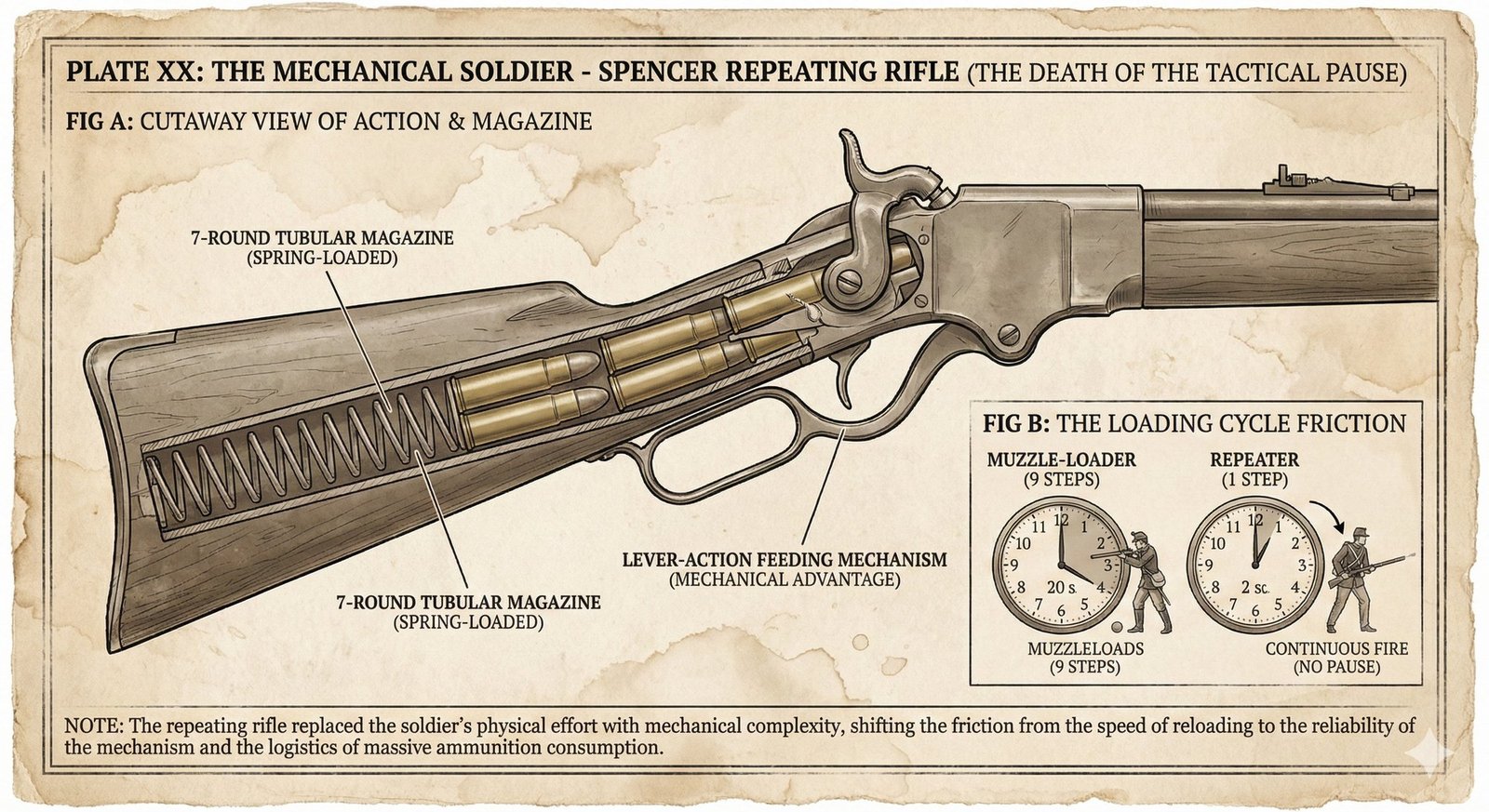
Loading took nine steps. An experienced soldier fired two or three shots a minute.
How did the Confederacy arm its soldiers?
In 1861 the Confederacy owned roughly 285,000 to 300,000 military firearms. About 175,000 of them were modern shoulder arms, and about 140,000 of those were smoothbores.
Virginia troops seized the Harpers Ferry armory on April 17, 1861, and shipped its machinery to Richmond and Fayetteville. Southern factories made about 107,000 shoulder arms by the end of the war. The Confederacy imported more than 340,000 European arms.
Josiah Gorgas, the Confederate ordnance chief, filled the gaps from four sources. He bought arms, manufactured them, seized them, and gathered them from battlefields.
Southern cavalry often fell back on shotguns early in the war. In January 1862, Colonel W. H. Jenifer commanded 500 men of the 8th Virginia Cavalry. He reported they carried “mostly old shotguns, bowie knives, and a few long range rifles.”
Which rifles and carbines did a Civil War cavalryman carry?
A Union trooper at Gettysburg carried three weapons: a breech-loading carbine, a cap-and-ball revolver, and a saber. His carbine might be a Sharps, a Burnside, a Gallager, or a Merrill. Manufacturers built almost 90,000 Sharps carbines, and by 1863 it was the most common weapon in Union cavalry regiments. Most respondents to a late-war survey called the Merrill “worthless.”
Each revolver chamber took loose powder, a ball, and a percussion cap. The government bought at least 129,730 Colt Army Model 1860 revolvers. The Colt’s effective range ran 50 to 75 yards.
The saber divided opinion, though most Union cavalry received one by early 1862. John Mosby used his as a spit and discarded it as soon as he could. Wade Hampton’s cavalry were said to like nothing so well as a chance to use their sabers. Jubal Early complained that Confederate cavalry armed only with rifles stood at a severe disadvantage in open country.
Which repeating rifles and carbines did the Union buy?
Two rifles loaded from a magazine. Christopher Spencer designed his lever-action repeater in 1860, and its tube held seven rounds. Benjamin Tyler Henry designed a rifle with a magazine of fifteen or sixteen rounds, depending on the source.
Army leaders hesitated because a Spencer cost about $40 in 1861, several times the price of a Springfield. The Ordnance Department also feared that soldiers would waste ammunition by firing too rapidly. After Gettysburg, President Lincoln watched a Spencer demonstration on the White House lawn. He ordered Ordnance chief James Ripley to adopt the rifle. Ripley kept buying single-shot rifles, and the Army replaced him later that year.
The federal government bought more than 95,000 Spencer carbines but only 1,731 Henry rifles. Soldiers bought many Henrys with their own money.
Colonel John Wilder’s brigade armed itself with Spencers in 1863. Wilder borrowed from his hometown bank, and each man co-signed a $35 loan. Wikipedia says the government paid for the rifles before the men spent any of their own money. Confederates captured some Spencers but could not make the cartridges, because of a copper shortage.
How did repeating rifles change cavalry tactics?
Cavalry went on foot. Troopers rode to the field and fought dismounted. Bilby writes that every fourth man held horses behind the skirmish line. A dismounted unit lost a quarter of its firepower.
Horsemen became mounted infantry. On June 24, 1863, Wilder’s brigade pushed ahead of the main Union column to Hoover’s Gap in Tennessee. Wilder’s men carried Spencer repeaters. Wilder dismounted them and refused an order to fall back. By 7 p.m., units from two divisions of the main force reached the gap.
Spencer fire held a second position at Chickamauga. On September 18, 1863, Wilder’s brigade guarded Alexander’s Bridge over West Chickamauga Creek. The American Battlefield Trust describes two charges from Liddell’s Confederates. The monument page at ironbrigader.com names five Mississippi regiments under Walthall. It says Wilder held until late afternoon, when the Confederates crossed the creek at other points. On September 20, the Trust says Spencer fire pushed back Hindman’s division. It adds that Longstreet briefly thought a new Federal corps was on the field.
Industry set the limits. Springfield Armory averaged 600 rifle-muskets a day in 1863, while the Confederacy worked from captured machinery, imports, and battlefield pickups.
Training lagged. A publisher’s summary of Earl Hess’s book says soldiers received too little training.
Some historians argue that the rifle-musket altered tactics less than older accounts claim. Hess finds that regiments with rifle-muskets opened fire at about 100 yards, the old smoothbore range. Paddy Griffith found that Union cavalry charges on infantry failed for reasons other than the rifle. Jones fired at 600 yards, yet most regiments opened fire at a sixth of that distance.
Hashtags: #CivilWar #CivilWarHistory #CivilWarWeapons #CivilWarCavalry #SpencerRifle #WildersBrigade #Chickamauga
Sources
- American Battlefield Trust, “Small Arms of the Civil War”
- Joe Bilby, Civil War News, “Carbine Folklore at Gettysburg”
- National Park Service, “The Arms of the Confederacy”
- Essential Civil War Curriculum, “Small Arms and Ammunition”
- Civil War News, “A Confederate Cavalry Shotgun”
- Hess, “The Rifle Musket in Civil War Combat” (review summary)
- Wikipedia, “Cavalry in the American Civil War”
- American Battlefield Trust, “10 Facts: The Battle of Chickamauga”
- Wilder Brigade Monument at Chickamauga
- Wikipedia, “John T. Wilder”
- Wikipedia, “Battle of Hoover’s Gap”
- Wikipedia entries for the Springfield Model 1861, Pattern 1853 Enfield, Sharps rifle, Spencer repeating rifle, Henry repeating rifle, and Colt Army Model 1860