A Civil War soldier loaded his rifle-musket in a set order. He poured the powder, rammed the bullet, and cocked the hammer. Then he pressed a copper cap onto a nipple at the breech. The hammer fell, the cap flashed, and the rifle fired.
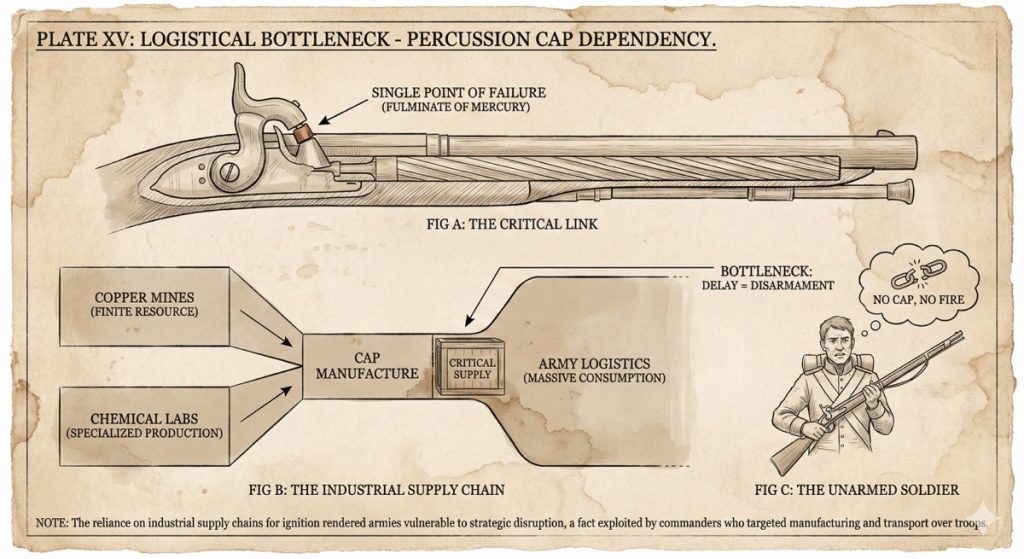
Without that cap, a rifle was a heavy club. Armies in 1861 relied on a part smaller than a fingertip, and few officers planned for it.
A cap beats the flintlock
Soldiers needed a better spark. Flintlocks often failed in rain and wind. Fulminate of mercury, a chemical that explodes when struck, solved the problem. Edward Howard discovered it in 1800, and Scottish minister Alexander Forsyth patented a fulminate lock in 1807. His primer mixed fulminate of mercury, chlorate of potash, sulphur, and charcoal. Forsyth hunted birds, and the flash from a flintlock pan warned them before the shot arrived.
Historians still argue over who made the first copper cap. Joshua Shaw said he built caps from iron, then pewter, then copper, starting around 1814. He moved to America in 1817 and patented a copper cup in 1822. His mix held chlorate of potash, fulminate of mercury, and powdered glass. Congress later paid him 25,000 dollars. The caplock fired in bad weather, and armies converted their muskets to it.
The design stayed simple. A cap is a small copper cup, closed at one end, with a pinch of explosive inside. It sits on a nipple linked to the barrel. The hammer strikes it, and a spark runs down into the powder. A hollow in the hammer caught the fragments and shielded the shooter’s eyes.
A clever idea that failed
Caps still caused trouble. They were tiny, and soldiers fumbled and dropped them in combat and on horseback. So inventors looked for a way to feed caps by machine.
Edward Maynard, a New York dentist who left West Point for health reasons, patented a tape primer in 1845. It placed priming cups on a varnished paper strip. Each time the soldier cocked the hammer, a spring advanced the strip. No fumbling was needed.
The Army liked the idea. Secretary of War Jefferson Davis backed it, and in 1854 the government paid Maynard 50,000 dollars for unlimited use. Davis later led the Confederacy, which would struggle to find copper for plain caps. The Springfield Model 1855, the Army’s first rifle-musket, carried the system. Springfield and Harpers Ferry built tens of thousands of them.
Then the tape failed. Moisture soaked the paper despite the varnish. A spark in one cup could set off its neighbors in a chain fire. The spring often misfed the strip. Army tests in 1859 and 1860 found that half the primers misfired. A foil-wrapped tape improved matters, but not enough.
The Army dropped the tape as the war began, and the simpler Model 1861 returned to the plain cap. Most Model 1855 rifles fought with ordinary caps too.
The Brown’s Island explosion
Making small parts was dangerous work. On 13 March 1863, the Confederate Laboratory on Brown’s Island in Richmond exploded. The lab made cartridges, fuses, and friction primers, and it could turn out 200,000 rifle cartridges a day. Friction primers lit artillery charges, not rifles, but the risk was the same.
Mary Ryan, age 18, loaded primers there. One stuck in a wooden block, and she banged the block on a table. A spark lit loose powder, and ten people died at once. A second blast lifted the roof and dropped it on the survivors.
The National Park Service counts about 50 dead, including Ryan, who died three days later. About half of the lab’s 600 workers were women and girls, and most earned one or two dollars a day. Safety rules were thin, and training in handling explosives was little. The lab reopened within months, because workers needed the pay.
When the copper ran short
Every shot needed a cap, and every cap needed copper, mercury, and nitric acid. The North mined its copper in Michigan’s Upper Peninsula. The South owned few deposits, and its best mines lay at Ducktown, Tennessee.
Accidents hurt too. On 23 December 1861, a fire at the Nashville Ordnance Depot destroyed two million caps, and nobody knows the cause. Two months later, Union troops entered Nashville. The Confederacy lost both the caps and the city.
The Confederacy imported its mercury, and the Union blockade made that harder each year. At one point the South ran out of nitric acid. It issued about three million caps made with a substitute mix, and the mix failed in damp weather.
Then came the copper itself. In 1861, Julius Raht built the only copper rolling mill in the Confederacy, at Cleveland, Tennessee. Union cavalry under Colonel Eli Long destroyed it on 25 November 1863. A Confederate ordnance officer reported that about 90 percent of Southern copper production was lost.
The ore still lay in the ground. Ducktown’s mines reopened in 1866 and produced more than one million pounds in their first full year. The Confederacy lacked the mills to use that ore.
After the mill fell, the South stopped casting bronze field guns and hoarded copper for caps. Richmond arsenal chief William LeRoy Broun wrote that caps in the final year came from North Carolina copper stills.
What the cap teaches
Armies adopt big tools with ease and forget the small parts behind them. The Delafield Commission studied rifles, guns, and railways in Europe in 1855 and 1856. A rifle still depended on one copper cup.
I found no record of a unit that lost a battle for lack of caps. The risk stayed real anyway. A fire, a lost mill, or a bad batch could silence a regiment.
For more of this history in story form, read the free Antietam prologue: bit.ly/tfo-antietam-prologue. Then explore the Steel and Honor series at tomfoconnor3.com.
Sources
- Wikipedia, Percussion cap
- HistoryNet, “How a Dentist Developed a Clever, but Flawed, System for Discharging Firearms”
- Wikipedia, Springfield Model 1855
- Wikipedia, Maynard tape primer
- Cleveland Civil War Round Table, “No Caps, No Guns: The Struggle for Confederate Copper”
- Emerging Civil War, “East Tennessee and Confederate Copper”
- National Park Service, Mary Ryan