He aimed perfectly. The man still stood.
The soldier raised his rifle and trusted his training. He lifted the barrel for the old arc. He squeezed the trigger. Smoke swallowed the target. When the haze thinned, the man still stood.
Not a miss of nerve. Not a shaking hand. His body remembered the wrong weapon. His aim belonged to a smoothbore musket. The rifle in his hands fired flatter and farther. At 300 yards, old training betrayed a good soldier.
Military observers documented this exact failure in 1855. New weapons in old hands did not produce better soldiers. They produced soldiers who missed in a new way.
From 1848 to 1860, the United States Army witnessed every major advance in infantry rifles, artillery, and repeating weapons. Observers traveled to Crimea. They visited European arsenals. They tested new designs at home. They generated some of the most detailed weapons reporting of the century.
The Army’s leading ordnance officer then concluded that American weapons were already good enough.
This is not a story about technology failing soldiers. It is a story about the men who best understood that technology. They watched it demonstrated on an active battlefield. Then they chose the comfortable answer over the correct one. Those choices shaped every engagement of the war that followed.

1848: Victory in Mexico Became Its Own Blindfold
The Mexican War ended in 1848 with American forces in Mexico City. Winfield Scott’s infantry carried smoothbore muskets. His artillery used bronze six-pounder and twelve-pounder guns, designs rooted in Napoleonic-era warfare.
It worked. That was the problem.
The Springfield Model 1842 fired a .69-caliber round ball. For aimed fire, it reached 75 to 100 yards with any reliability. In close formations, infantry fired together, compensating for each weapon’s inaccuracy through volume. A man at 200 yards stood reasonably safe from a smoothbore musket line.
Scott’s victories reinforced generate tactical thinking. Close formations. Short engagement ranges. Massed volley fire. Bayonet charges still decided some actions. Every lesson from Mexico pointed to familiar methods.
Twelve years later, the Army carried weapons that made those methods suicidal. Several senior officers knew it. Most chose to say otherwise.

Early 1850s: The Minié Ball Changed the Battlefield
Rifled barrels existed for decades before the Civil War. The problem was loading speed. A tight-fitting ball gripped the rifling and flew true. But pushing one into the grooves under combat conditions took too long. Speed mattered as much as accuracy in a firefight.
French Captain Claude-Étienne Minié solved that problem with a hollow-base expanding bullet. It sat loosely in the barrel. A soldier loaded it fast, almost like a ground ball. When fired, expanding gas forced the soft lead base outward into the rifling grooves. The bullet caught the spiral and flew true.
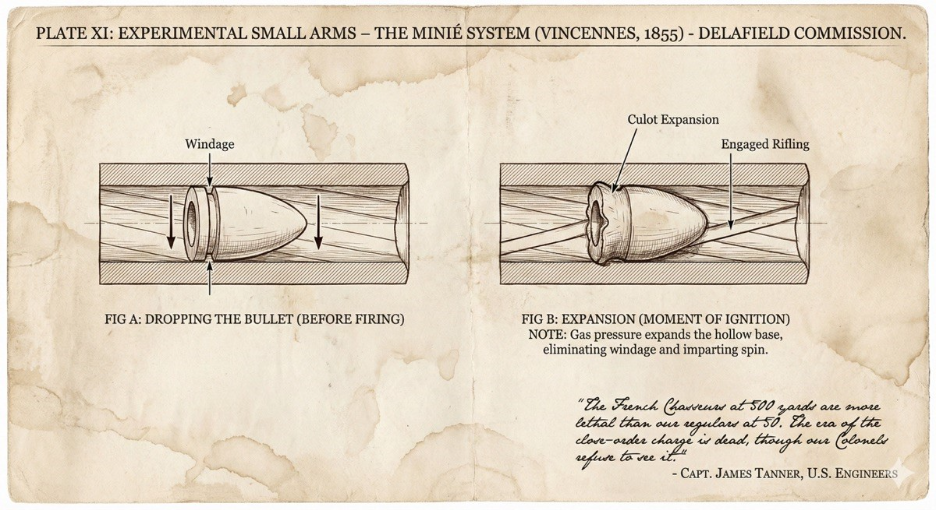
James Burton at Harpers Ferry refined the design for American use. He eliminated the iron plug Minié used and found the hollow base expanded without it. His version became cheaper and easier to produce. It became the U.S. standard in 1855.
The Springfield Model 1855 carried this new firepower into service. The range shift was not incremental. The Springfield Model 1842 smoothbore reached under 100 yards for aimed fire. The Springfield Model 1855, a .58-caliber rifled musket reached 500 yards. It remained dangerous past 1,000 yards.
The rifled musket did not make every soldier a marksman. It made every open field more dangerous.
Table 1: Civil War Infantry Weapons Range Comparison
,,
| Weapon | Type | Practical aimed range | Extended danger range | Battlefield meaning |
| Springfield Model 1842 | Smoothbore musket | About 75 to 100 yards | Inaccurate beyond that | Favored close-order volley fire |
| Springfield Model 1855 / 1861 | Rifled musket | Deadly around 400 yards in trained hands | Dangerous farther, accuracy fell sharply | Expanded the infantry killing zone |
| Sharps rifle or carbine | Breech-loading rifle | About 400 to 500 yards | Faster reload under cover | Useful for cavalry and specialist troops |
| Whitworth rifle | Precision rifled arm | About 800 yards in trained specialist hands | Sometimes claimed farther | Rare specialist sharpshooter weapon |
Rifled muskets did not make every soldier a long-range killer. Smoke, fear, poor range estimation, and weak marksmanship training reduced battlefield accuracy. But the danger zone expanded. A distance that once gave a soldier some safety now placed him inside rifle fire.

When New Technology Outran Its Own Training
Jefferson Davis recognized the tactical problem in 1852. As Secretary of War, he commissioned William Hardee to write a new tactics manual for rifle-armed infantry. “Rifle and Light Infantry Tactics” appeared in 1855. Davis signed the War Department certification on March 29, 1855.
The manual acknowledged what rifle range meant. Soldiers could no longer stand and move as if every fight began at smoothbore distance. Skirmishers mattered more. Spacing mattered more. Cover mattered more.
The manual reached the Army. The habits moved more slowly.
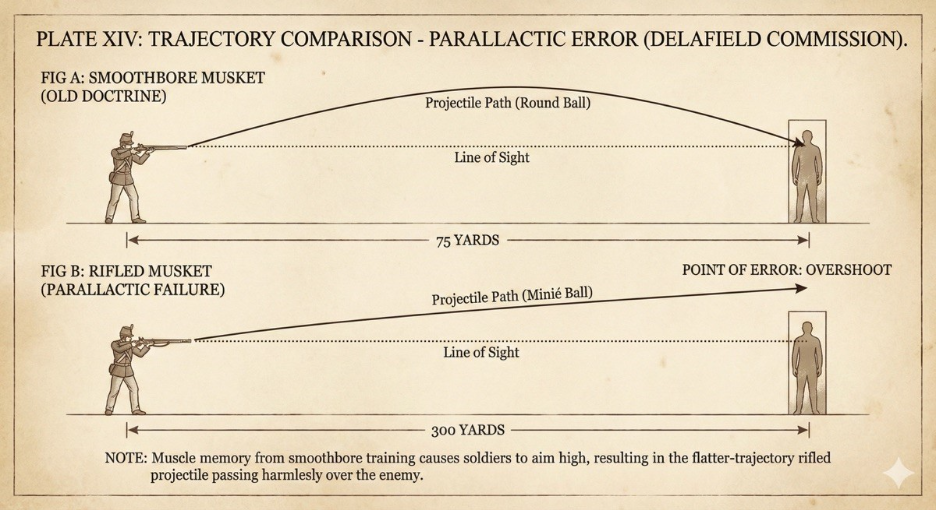
A soldier trained on the smoothbore musket learned to compensate for its steep arc. He aimed above the target. His body learned that angle over years of drilling. When the Army placed a rifled musket in his hands, the trajectory changed. The Minié ball flew flat. The soldier still aimed high from muscle memory. His bullet sailed over the target at combat distance.
A new manual does not change a soldier’s body. It does not erase decades of drill. Officers could read the future and still march into the past.
The Springfield Model 1855 brought a second flaw. The Maynard tape primer fed percussion caps automatically when the soldier cocked the hammer. In dry conditions, it worked. In wet field conditions, the paper tape absorbed moisture and misfired. The Army returned to the standard percussion cap in the Model 1861.
That failure gave cautious officers a reason to distrust mechanical innovation. It also exposed a deeper vulnerability.
Every rifle in service needed small copper caps filled with fulminate of mercury. Major Alfred Mordecai, the Army’s leading ordnance expert, understood this dependency better than almost anyone. Armies needed caps by the millions. Copper came from mines. Fulminate required specialized chemical production. A flintlock relied on local stone. The new percussion rifle belonged to an industrial supply chain at every level. Disruption anywhere along that chain disarmed the most modern rifle in the field.

1855-1856: The Delafield Commission Saw the Future in Crimea
Jefferson Davis sent three officers to observe the Crimean War in 1855. Major Richard Delafield led the group. Major Alfred Mordecai studied artillery and small arms. Captain George McClellan examined cavalry organization. Davis directed them because European weapons now appeared on active battlefields. The United States risked falling behind.
The commission published three separate reports in 1860 as Senate Executive Documents. Delafield’s report included 57 folding maps and technical drawings. Mordecai’s arms report added 34 plates documenting weapons in precise detail. Both are available today through the Library of Congress.
At Sevastopol, Delafield watched rifled artillery fire against masonry walls.
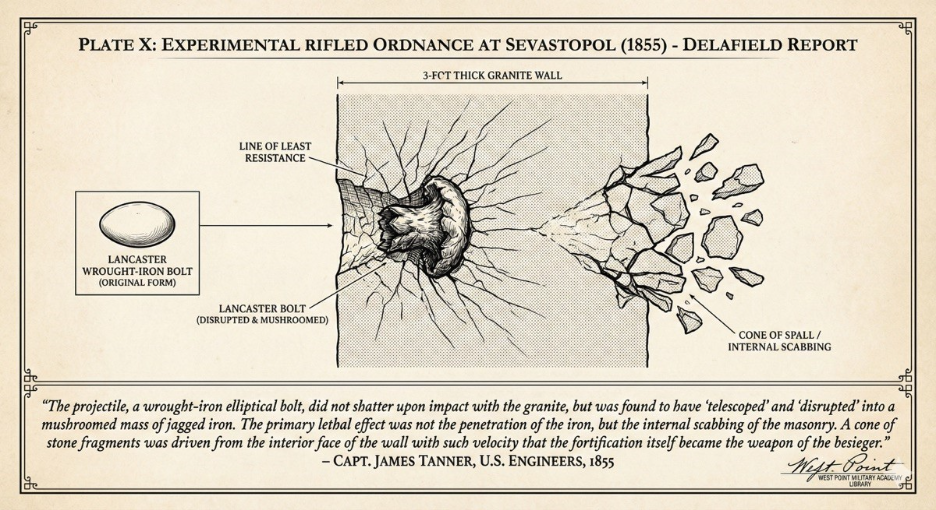
A British Lancaster gun fired an elliptical wrought-iron bolt into three-foot-thick granite. The bolt mushroomed on impact. The primary damage came from spalling. A cone of stone fragments drove inward from the rear wall face at high velocity. The granite killed the men sheltering behind it.
Every masonry fort in the U.S. military inventory was now vulnerable to this effect. Earth absorbed the projectile’s energy. Masonry amplified it into shrapnel. Delafield returned home and argued for earthwork construction.
Then Mordecai published his conclusions on repeating and breech-loading weapons.

Mordecai and the Institution Behind the Decision
Mordecai was one of the Army’s finest ordnance minds. He watched the Prussian needle-gun. That breech-loader gave Prussian infantry a decisive rate-of-fire advantage over every muzzle-loading army in Europe. He called it too “complicated.” He watched breech-loading rifles in French Imperial Guard trials. He concluded they were “not adapted to the ordinary vicissitudes of military service.”
His recommendation: the Springfield muzzle-loader was the right choice. American weapons were not behind Europe. They were ahead.
Mordecai’s caution was not irrational. Early breech-loaders raised genuine concerns about fouling, ammunition supply, cost, and soldier training. His error was not that he saw problems. His error was trusting caution too long.
But Mordecai did not act alone. The Ordnance Department, as an institution, reinforced every conservative choice he made. Procurement officers saw cost and complexity at every turn. The Springfield cost under fifteen dollars. The Spencer cost up to forty. Adoption meant new training, new supply chains, and new logistics. The Army already stretched itself across thousands of miles of frontier. Institutions reward what worked last time. The Ordnance Department rewarded Springfield. Mordecai’s report gave that preference a technical foundation and a published authority behind it.
The soldiers who carried Spencers at Chickamauga in 1863 wrote home to say otherwise.

Artillery: When Safe Distances Disappeared
Rifled artillery extended every problem to a larger scale.
The M1857 Napoleon smoothbore remained a trusted field gun. It fired solid shot, shells, spherical case, and canister. At close range, with canister, it was devastating. But rifled artillery reached farther with greater accuracy.
The 3-inch Ordnance Rifle threw its projectile at 1,215 feet per second and reached over 4,100 yards. Robert Parrott developed rifled cast-iron artillery at the West Point Foundry in Cold Spring, New York. A thick wrought-iron reinforcing band over the breech, applied hot and contracted as it cooled, handled the higher chamber pressures. His 10-pound Parrott rifle reached past two miles. At 1,500 yards, a rifled shell retained two-thirds of its muzzle velocity. A smoothbore round retained one-third.
Table 2: Civil War Artillery Range Comparison
,,
| Weapon | Type | Typical battlefield role | Approximate range | Battlefield meaning |
| 6-pounder field gun | Smoothbore artillery | Older field gun | Shorter than rifled guns | Useful but increasingly outdated |
| 12-pounder Napoleon | Smoothbore artillery | Close and medium range | About 1,500 to 1,600 yards | Deadly with canister and reliable |
| 3-inch Ordnance Rifle | Rifled field artillery | Long-range shell and case shot | About 1,830 yards at 5 degrees | Accurate at longer range |
| 10-pounder Parrott Rifle | Rifled field artillery | Long-range bombardment | Up to about 1,900 yards | Powerful, less trusted than wrought-iron |
Rifled artillery did not replace smoothbore guns overnight. The Napoleon remained deadly at close range. But rifled guns made distance less protective. Older officers could no longer assume that distance shielded men, batteries, roads, or bridges. The battlefield stretched. Too many commanders still measured it with old eyes.
Infantry formations that moved safely beyond smoothbore artillery range now stood well inside effective rifled gun range. Engineers who read the Delafield report understood this before the war began. Their recommendations for earthwork construction met consistent resistance from commanders who trusted what they already knew.

Late 1855: Texas Became the Army’s Frontier Proving Ground
While Delafield, Mordecai, and McClellan studied war in Europe, another lesson took shape on the American frontier. It came not from formal reports or European arsenals. It came from patrols.
In 1855, the Army organized the 2nd U.S. Cavalry for service on the Texas frontier. The regiment crossed into Texas on December 15, 1855. This was not a formal weapons trial in any modern sense. It was harsher than that.
A carbine in Texas faced dust, heat, hard riding, and long patrols. Supply lines were weak. Enemies knew the ground better than any pursuing soldier.
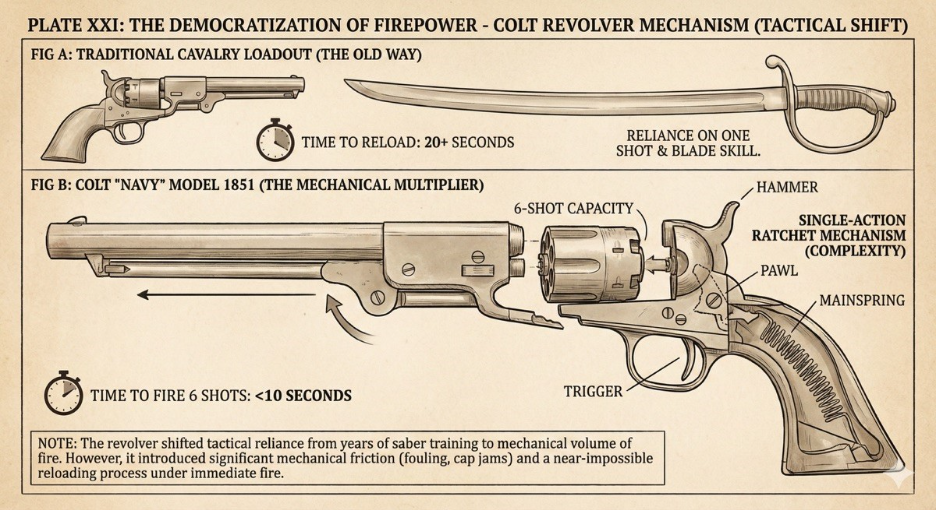
The Colt Navy Model 1851 gave mounted men six shots before reloading. The traditional cavalryman carried one pistol requiring more than twenty seconds to reload and a saber demanding years of training. The Colt fired six shots in under ten seconds. Mechanical volume replaced blade skill. On the frontier, a cavalryman needed more than a powerful first shot. He needed a faster second one.
The officers watching this were not obscure men. Albert Sidney Johnston commanded the regiment. Robert E. Lee served as lieutenant colonel. William J. Hardee, George H. Thomas, Earl Van Dorn, Edmund Kirby Smith, John Bell Hood, and George Stoneman all served in that regiment. The war that came would place those names on opposite sides of every major campaign.
The muzzle-loader’s problem on the Texas frontier was not power. It was time.
Tear the cartridge. Pour the powder. Seat the bullet. Draw the ramrod. Ram the charge. Return the rod. Cap the nipple. Aim again.
On a drill field, discipline made the process look smooth. On the Texas frontier, it could prove fatal. Comanche warriors used speed, distance, surprise, and repeated fire. They closed fast, scattered, shot, wheeled away, and returned from another angle. The bow did not outrange the
rifle. It did not strike with the same force. But at close range, in the hands of a skilled mounted archer, it offered speed, silence, and repeated shots. That gap mattered.
The Delafield Commission showed what modern war looked like abroad. Texas showed what old assumptions cost, one patrol at a time.

Nathaniel McAllister and the Lesson of the Faster Second Shot
In “Cadets to Captains: 1848-1860,” Nathaniel McAllister’s service with the 2nd U.S. Cavalry places him inside the Army’s second classroom. The first classroom was Europe. The second was Texas.
Nathaniel does not learn war from reports alone. He learns it from dust, thirst, bad maps, tired horses, and sudden danger. He sees what a long arm can do when the enemy stays at range. He also sees what happens when mounted fighters refuse to stand still long enough for old doctrine to matter.
A muzzle-loader can dominate a firing line. In a swirling, mounted fight, it becomes clumsy. A trooper who fires once and reaches for the ramrod loses time he may not get back. A man with a revolver fires again. A man with a breech-loading carbine reloads without the slow ritual.
Nathaniel understands the difference because Texas teaches it without mercy.
That lesson follows him into the Civil War. When he studies cavalry movement, signal work, logistics, and battlefield timing, he carries the memory of frontier service. He knows war punishes delay. He knows the second shot matters. He knows the weapon is only part of the answer. Doctrine must move as fast as the fight.
He belongs to the generation caught between two military worlds. The Delafield Commission showed what modern war looked like abroad. Texas showed what old assumptions cost at home. Nathaniel carries both lessons into a war shaped by the gap between them.

Repeating Weapons: The Gap Between Evidence and Decision
Christian Sharps patented his breech-loading rifle on September 12, 1848. The falling-block mechanism allowed reloading without a ramrod. Accuracy reached 400 to 500 yards. Cavalry units that received Sharps carbines praised them. The Army bought limited numbers, cited cost, and stayed with the muzzle-loader.
Then Christopher Spencer patented his repeating rifle in 1860.
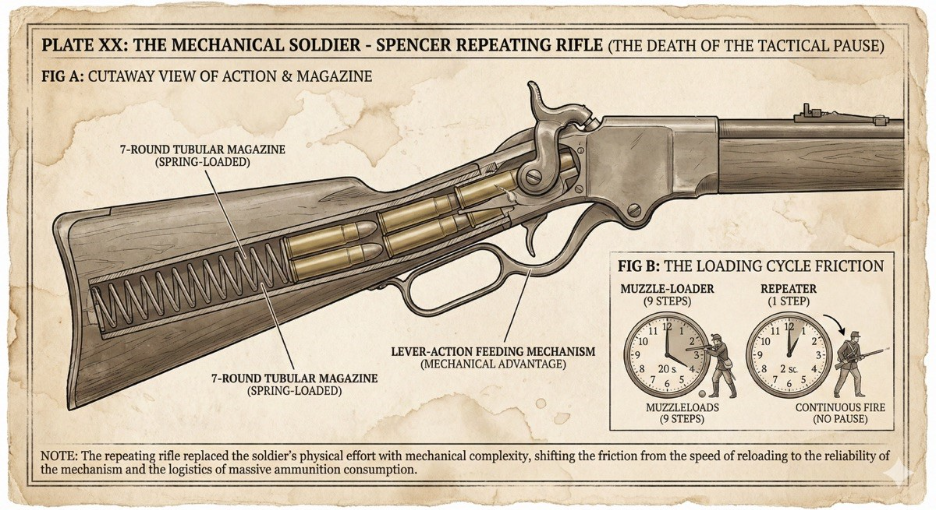
The 7-round tubular magazine in the stock, fed by a lever-action mechanism, reduced nine loading steps to one. A muzzle-loader required roughly twenty seconds per shot. A Spencer required about two. A Springfield cost under fifteen dollars. A Spencer costs up to forty. The Army bought Springfields. Mordecai’s report gave the Ordnance Department the technical cover it wanted.
Procurement officers saw expenses and complexity. Soldiers saw survival. Both views contained truth. Only one view mattered when the line broke.

Precision Sights and the Officer as Target
Repeating weapons changed how many shots a soldier fired. Precision sights changed who he could choose to hit.
Optical sights and Whitworth rifle iron Vernier sights extended accurate individual fire to 800 yards in trained specialist hands.
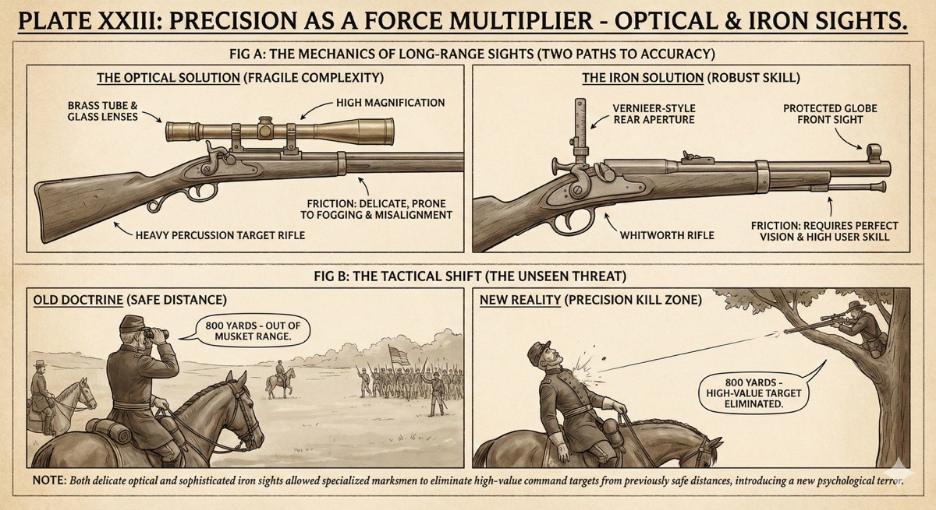
Under smoothbore doctrine, an officer at 800 yards stood safely outside common musket range. Under the new reality, he stood in a precision kill zone. Marksmen targeted officers by rank insignia. The officer’s courage did not vanish. But courage needed new habits. Use cover. Dismount when needed. Avoid unnecessary display. Read the ground before crossing it.
The weapons did not care which man felt braver.

Earthworks Were Not Cowardice
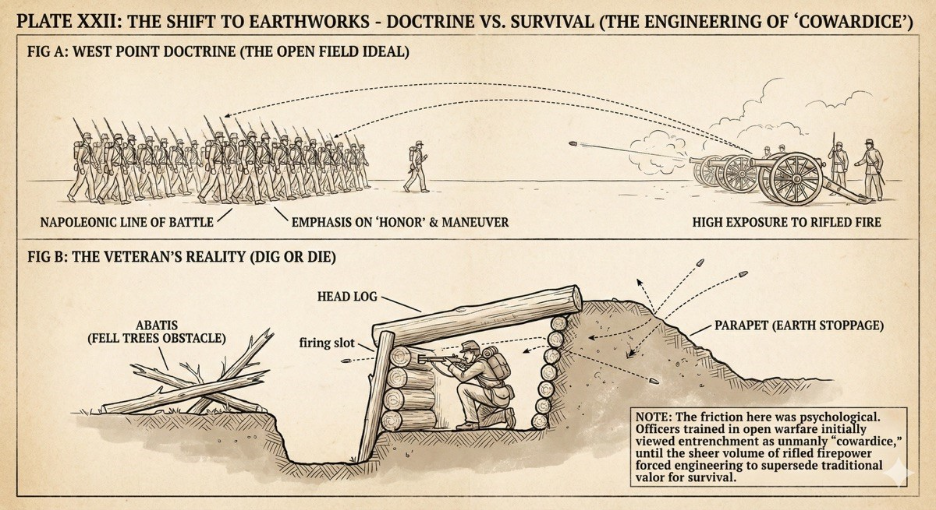
West Point taught engineering. American officers knew how to dig. Yet many viewed entrenchment with suspicion. In older thinking, too much digging suggested fear. Forward movement showed spirit. Open-field attack proved resolve.
Crimea challenged that. At Sevastopol, earthworks saved men. Trenches shaped battle. Packed soil proved stronger than stone or pride.
A shovel saved more lives than a speech. The men who understood that early gained an advantage. The men who learned it late paid in blood.

What These Officers Carried Into the War
The weapons were ready. The war was two years away.
The officers in “Cadets to Captains: 1848-1860” train in this world. They fire the new rifles. They read Hardee’s manual. Some know the men who went to Crimea. Nathaniel McAllister rode patrol in Texas and learned what the reports alone could not teach.
What the novel follows is the gap between knowing and acting on what you know.
A cadet can study the trajectory drawings. He can fire the Springfield and feel differing the smoothbore. He can read every page of the commission reports. He still marches toward a war carrying the assumptions of the decade before. Those assumptions live in how he stands, how he thinks, and who taught him.
The weapons changed in twelve years. The thinking took longer. The distance between those two timelines, measured in the years that followed, cost more than any mechanical failure.
Before the first cannon fired at Sumter, the war already formed in classrooms, arsenals, European reports, and Texas dust. “Cadets to Captains: 1848-1860” follows the young officers standing in that uneasy space, armed with old loyalties and new weapons. They are cadets, engineers, cavalrymen, husbands, brothers, and friends. They study honor in classrooms, on parade fields, and along distant frontiers. Some will see the next war coming. Some will learn too late.
If you want Civil War fiction grounded in genuine history and West Point brotherhood, this is where the journey begins. The novel covers frontier service, military innovation, divided loyalty, and the human cost of command.
Order “Cadets to Captains: 1848-1860” today at tomfoconnor3.com
For more history behind the Steel and Honor series, read more at tomfoconnor3.com.

Frequently Asked Questions
What was the Delafield Commission? The Delafield Commission was a U.S. military observation mission sent to the Crimean War in 1855 by Secretary of War Jefferson Davis. Major Richard Delafield led the group. Major Alfred Mordecai studied arms and artillery. Captain George McClellan examined cavalry and military organization. The group studied European weapons technology and published detailed reports in 1860. Those reports influenced, and in some cases failed to influence, American military doctrine before the Civil War.
How did the Minié ball change infantry warfare? The Minié ball was a hollow-base expanding bullet that solved the loading problem of rifled muskets. It dropped into the bore before firing and expanded into the rifling grooves at ignition. It combined the speed of a smoothbore with the accuracy of a rifle. It extended effective infantry range from under 100 yards to 500 yards and changed the distances at which people fought battles.
Why did rifled muskets change Civil War combat? Rifled muskets fired farther and more accurately than smoothbore muskets. This made older close-order tactics more dangerous. Soldiers came under effective fire before they reached traditional musket range. Formations that worked in Mexico became costly in Virginia.
What was the parallactic error in Civil War rifle training? Parallactic error describes the training failure that occurred when soldiers trained on smoothbore muskets switched to rifled weapons. Smoothbore rounds traveled in a high arc, so soldiers learned to compensate by aiming above the target. The rifled musket’s Minié ball flew flat. Soldiers kept their smoothbore muscle memory and aimed too high. Shots passed over targets even at close ranges. Re-equipping hands and habits required more time than re-equipping the Army with new rifles.
Why did the U.S. Army not adopt repeating rifles before the Civil War? The Army’s leading ordnance expert, Major Alfred Mordecai, observed European repeating and breech-loading weapons during the 1855 Crimean commission and recommended against adoption. He called the Prussian needle-gun too “complicated” and stated that breechloaders were “not adapted to the ordinary vicissitudes of military service.” Cost reinforced the decision. A Springfield rifle cost under fifteen dollars. A Spencer repeating rifle cost up to forty. The Ordnance Department, as an institution, rewarded the familiar choice. Mordecai’s report gave that choice a published technical foundation.
Was the 2nd U.S. Cavalry a formal weapons testing unit? Not in the modern sense. It served as a frontier proving ground. Texas tested weapons, horses, equipment, and officers under hard field conditions. The regiment’s officer corps included some of the war’s most prominent commanders: Lee, Johnston, Hardee, Thomas, Van Dorn, Kirby Smith, Hood, and Stoneman among them.
Did muzzle-loaders struggle against mounted Native warriors on the frontier? Yes, in some close-range frontier fights. Muzzle-loading firearms carried greater range and power than bows, but they reloaded slowly. Against mounted warriors who moved fast and fired repeatedly, that delay became dangerous. Frontier service pushed the Army toward revolvers and breech-loading carbines as a direct response to this problem.
Why did revolvers matter on the Texas frontier? Revolvers gave mounted men several shots before reloading. That answered the rate-of-fire problem posed by fast-moving opponents. The Colt Navy Model 1851 fired six shots in under ten seconds. A man with a single-shot pistol and a saber depended on one accurate shot and years of blade training. The Colt changed that balance.
How does Nathaniel McAllister’s 2nd Cavalry service matter in “Cadets to Captains”? Nathaniel’s frontier service gives him practical experience with weapons, movement, supply, and timing under real field conditions. He learns that range alone does not win a fight. The second shot, the terrain, and the pace of combat matter too. That knowledge shapes how he reads the Civil War when it comes.
How effective were Civil War rifle scopes? They were effective in trained specialist hands, on precision rifles like the Whitworth. But scopes were fragile, slow to use, and narrow in view. Smoke reduced their value. Poor light reduced their value. Moving targets reduced their value. They were specialist tools, not modern sniper scopes. Rifled muskets changed the danger zone for entire armies. Telescopic sights gave a few trained men a way to exploit the far end of that zone.
How does this history connect to “Cadets to Captains: 1848-1860”? The novel follows officers trained during the years when weapons changed faster than military thinking. Nathaniel McAllister’s 2nd Cavalry service adds the frontier lesson: firepower also depended on speed, mobility, and survival after the first shot. The book begins the Steel and Honor series at the moment before the break.

Primary Sources


