
Fun with NotebookLM
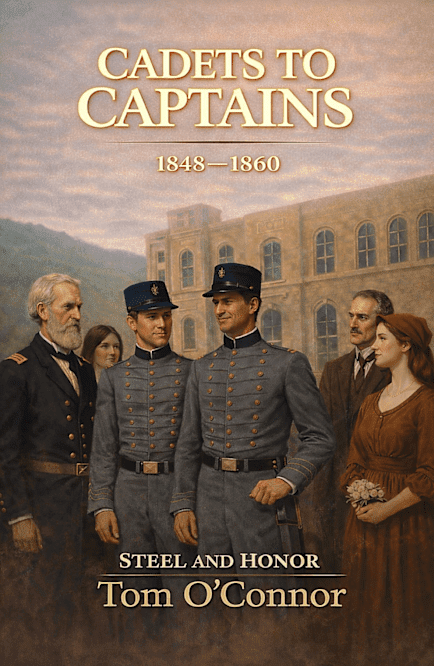
This morning I was learning more uses for NotebookLM. I input the full manuscript for Cadets to Captains: 1848-1860. Then I assigned a group of experts to debate the book then create a NYT Critic’s review of the book.
Thought I would share it with you. Take it with a piece of salt, but for me itwas fun after reading my editors first pass review of Chapter One. Enjoy!
A Roundtable Debate: The Relevance of Cadets to Captains
The Literary Critic: Tom O’Connor’s Cadets to Captains thrusts us into the rigid, atmospheric world of West Point in 1848, capturing the sensory overload of the “Thayer System” right down to the stifling wool uniforms and the smell of boiled coffee. From a literary standpoint, the book’s primary relevance is its exploration of a generation caught on the precipice of technological obsolescence. The protagonist, Nathaniel McAllister, realizes that his mastery of smoothbore ballistics and Napoleonic maneuvers is already being eclipsed by the steam engine and the telegraph. It perfectly mirrors our modern anxieties about rapid technological displacement.
The Editor: I agree that the technological themes are strong, but the pacing truly thrives on its structural subversion. O’Connor sets up a traditional military narrative about a “Scientific Vanguard” being sent to the harsh frontiers of Texas. But the most compelling hook is the “Conspiracy of Mothers” operating in the visitor stands. While the men obsess over parade intervals and frontier grit, Ann McAllister and Margaret Tanner are secretly running a shadow campaign called the “Arlington Plan”. The women are the true masterminds, leveraging social intelligence to coordinate with railroad liaisons and the War Department to ensure their sons dictate the future of transcontinental infrastructure.
The Social Media Expert: From an audience perspective, this book is a goldmine. BookTok and historical fiction fans will devour the “Gallery of Mothers” dynamic—it has the intricate societal maneuvering of Bridgertonbut revolves around military logistics and congressional committees. Furthermore, the romance feels incredibly fresh and relevant for today’s readers. When Nathaniel proposes to Clara Whitcomb, he doesn’t ask her to be a passive companion; he asks her to be his “partner in the science of what comes next”. Clara’s response—demanding he teach her the ballistic tables so they can be a “complete” vanguard—is the exact kind of demand for intellectual parity that modern audiences crave.
The Literary Critic: Precisely. The book argues that the physical conquest of the West was merely the superficial layer of American expansion. The true architects of the Republic were the women who manipulated the political map from the parlors, understanding that the future belonged not to the saber, but to the “iron horse and the lightning-wire”
The New York Times Book Review
The Architects of Empire: The Quiet Subversion of the American Frontier A Review of Tom O’Connor’s Cadets to Captains
Tom O’Connor’s Cadets to Captains, the opening installment of the Steel and Honor series, begins at the exact moment the romantic illusions of the “Old Army” die and the mechanized reality of the modern era takes over. Set against the granite facades of West Point during the graduation of the Class of 1848, the novel captures a cadre of young officers stepping into a nation expanding at the blistering, unmanageable speed of conquest.
O’Connor’s world-building is deeply tactile, immersing the reader in the punishing discipline of Sylvanus Thayer’s academy, where individuality is submerged into the collective geometry of the Corps. Our entry points are Nathaniel McAllister and James Tanner, newly minted officers of the “Scientific Corps” who acutely feel the anxiety of an impending industrial revolution. Though they have spent four years mastering permanent fortifications and analytical mathematics, they suspect their education is already obsolete in the face of the telegraph and the railroad.
However, O’Connor’s true masterstroke lies not in his depiction of marching cadets or blustering generals, but in his brilliant revelation of the “Conspiracy of Mothers”. While men like General Winfield Scott and Colonel Thomas McAllister pontificate about the crucible of the western frontier, the cadets’ mothers are orchestrating a sweeping, clandestine agenda known as the “Arlington Plan”.
Operating from beneath the shade of silk parasols, characters like Ann McAllister and Margaret Tanner recognize that nostalgic frontier warfare is a dead end. Unbeknownst to their husbands and sons, these women are actively manipulating the War Department and coordinating with railroad syndicates to ensure their sons are quickly recalled to the East to manage coastal rail integration. This subversion of patriarchal military tropes is thrilling; O’Connor proves that the women possess a tactical and logistical brilliance that easily rivals any field general.
This demand for female agency extends beautifully to the novel’s romantic arc. Clara Whitcomb, Nathaniel’s fiancée, rejects the role of a passive spectator awaiting the outcome of male conquest. She demands an intellectual parity rarely seen in the genre, insisting on learning the ballistic tables for light batteries before she agrees to follow Nathaniel into the Texas scrubland.
Ultimately, Cadets to Captains is a profound, meticulously plotted reflection on the sheer weight of American expansion. It is a masterful piece of historical fiction that persuasively argues the most decisive battles of 1848 were not fought in the dust of the frontier, but in the shaded verandas and parlors where the blueprints of an empire were quietly, ruthlessly drawn.
Leave a Reply